 Skip to content

Ask a room full of parents what their child did on a phone last night.
However, you will get a lot of confident answers.
Most of them are guesses.
Even school leaders carry real responsibility for keeping students safe, including cybersecurity for students in Qatar.
They often rely on what they overheard in the staff room or read in the news that week.
Meanwhile, students are already living inside group chats, gaming lobbies, short videos, and AI tools.
Moreover, they are not doing anything unusual.
Similarly, they are simply moving faster than the adults around them.
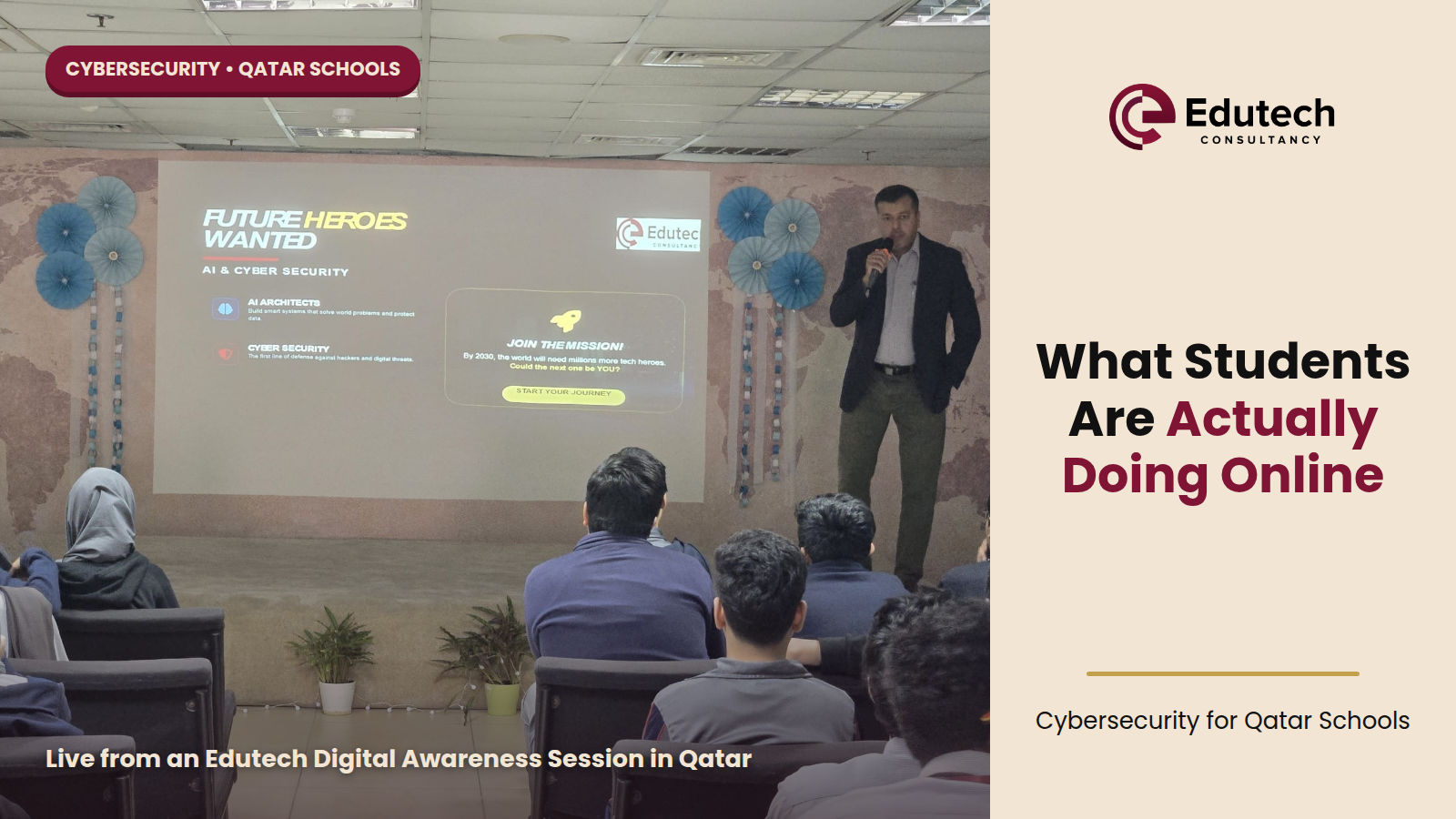
Firstly, at Edutech Consultancy, we run Digital Awareness Sessions in private schools across Doha. One thing has stood out every time. Moreover, this post looks at where students run into real trouble online. Furthermore, it explains why one assembly a year rarely changes anything. Additionally, what a cybersecurity talk needs to look like if it is going to stick.
We are mostly guessing
The gap between what adults assume and what students do is exactly where problems grow. A student who clicks a suspicious link usually does not mention it, because they assume they will get in trouble. So they stay quiet, and the school only finds out weeks later, if it finds out at all.
That is the actual first job of any cybersecurity talk. Not rules. Making it normal for a student to say, I think I made a mistake, without fear of being punished for it.
Four places students run into real trouble

Social media and private messages. Messages arrive from accounts a student barely knows. A photo sent to one friend somehow ends up with fifty people. Once something is out, there is no pulling it back.
Gaming chats. Many students spend hours in games with voice and text chat left on. That is where a stranger slowly becomes a friend, starts offering gifts inside the game, and eventually starts asking questions that have nothing to do with the game.
Fake offers and links. Free game currency, surprise giveaways, a message that looks like it came from the hacked account of a friend. These work precisely because they look ordinary. Plenty of adults fall for the same tricks.
AI chatbots. Students use them for homework, which is fine on its own. The problem is how many type in full names, school details or photos without a second thought about where that information ends up.
None of this needs a scary tone to land. It needs a calm explanation and a clear next step.
What we heard in Doha classrooms
We recently ran a series of these sessions in several private schools across Doha, covering online safety, responsible social media use, protecting personal information and understanding digital footprints. The sessions were led by Feroz, a CISO specialist with international and regional experience, who built the conversation around real scenarios rather than a slide deck of rules. Qatar Tribune covered the sessions not long after.
What stayed with us afterward was not the presentation. It was the questions. Some students asked whether AI would eventually replace certain jobs. Others wanted to know how to build a real career in cybersecurity. Nobody looked bored. Give students the real picture instead of a version that has been softened, and they lean in rather than switch off. Teachers told us it helped students understand why responsible online behavior matters, rather than just being another rule handed down.
If a session leaves a student curious about a technology career, that is worth something too. Our Cisco Networking Academy pathway includes CyberOps, and if you are wondering where a younger student might start, we wrote about why Python works well as a first language for teens in Qatar.
Why one assembly a year rarely works

A lot of schools hold a single yearly assembly. However, apps and trends shift every few months. A talk that happens only once is forgotten by the following Monday. For cybersecurity for students in Qatar, ongoing sessions matter.
The sessions that stay with students tend to share the same traits. They use examples students recognize from real life, not hypothetical cases. They talk about mistakes without assigning blame. They leave room for real questions instead of rushing to the next slide. They come back more than once during the year. Ideally, parents hear something similar at home.
Qatar already has good groundwork, so build on it
There is no need to start from zero. The education programs run by the National Cyber Security Agency, including the Cyber Echo project, have already reached more than 140,000 students across 200 schools, according to comments from the NCSA president reported by The Peninsula. The Ministry of Communications and Information Technology also runs Safe Space, which has games, tips and cyberbullying guidance built for students, parents and teachers alike.
Both are worth sharing with the wider school community. What national programs cannot do is know a specific school. They do not know which app a Grade 6 class is currently obsessed with, what devices are allowed, or how staff currently handle a report when one comes in. That part has to be built around the actual students in the room.
A simple starting point for school leaders
- Ask students first. A short, anonymous survey on which apps they use and what genuinely worries them will teach a school more than any assumption would.
- Brief staff before students. A teacher should not be caught off guard by something happening in their own classroom.
- Split sessions by age group. A Grade 4 class and a Grade 10 class need two completely different conversations, not one script stretched to fit both.
- Bring parents into it. Even a short summary sent home keeps the conversation going once the school day ends.
- Repeat it every term. Short refreshers work better than one big event, and each one is a natural moment to revisit device and data rules.

How Edutech Consultancy can help
Digital Awareness and Cybersecurity Sessions, interactive sessions built to protect students, staff and school systems from digital threats.
School Tech Consulting and Integration, we look at where the gaps are in school technology and recommend what fits.
Training and Professional Development, practical workshops so teachers feel confident having these conversations themselves.
Edubites Community, a space for educators across Qatar to compare notes on what is working well.
Final thought
Students will keep finding new apps, and adults will keep being a step behind. That part is never going to change. What makes the real difference is a school where a student feels safe enough to speak up, and staff who already know what to do when they do. A good conversation is where that starts, not where it ends. Want a session built for a specific school? Request a workshop or get in touch with the team.
